Ark How to Make Uploaded Canvas Picture Non Comicy
Popular fine art is an art motion that emerged in the Britain and the United States during the mid- to late-1950s.[one] [2] The motility presented a challenge to traditions of fine art by including imagery from popular and mass culture, such equally advertizement, comic books and mundane mass-produced objects. I of its aims is to use images of popular (as opposed to elitist) culture in art, emphasizing the bland or kitschy elements of whatever culture, virtually oft through the apply of irony.[3] It is also associated with the artists' employ of mechanical means of reproduction or rendering techniques. In popular art, material is sometimes visually removed from its known context, isolated, or combined with unrelated textile.[2] [3]
Amongst the early artists that shaped the popular art movement were Eduardo Paolozzi and Richard Hamilton in Britain, and Larry Rivers, Ray Johnson. Robert Rauschenberg and Jasper Johns amid others in the United States. Pop art is widely interpreted every bit a reaction to the then-dominant ideas of abstruse expressionism, every bit well as an expansion of those ideas.[iv] Due to its utilization of found objects and images, it is similar to Dada. Pop fine art and minimalism are considered to be art movements that precede postmodern art, or are some of the earliest examples of postmodern art themselves.[5]
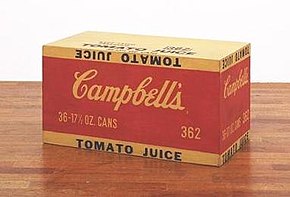
Pop art often takes imagery that is currently in use in advertising. Product labeling and logos effigy prominently in the imagery chosen by pop artists, seen in the labels of Campbell's Soup Cans, by Andy Warhol. Even the labeling on the outside of a shipping box containing food items for retail has been used as subject thing in pop art, every bit demonstrated past Warhol's Campbell'south Tomato Juice Box, 1964 (pictured).
Origins [edit]
The origins of pop fine art in North America developed differently from Great Britain.[3] In the United States, pop art was a response past artists; it marked a render to hard-edged limerick and representational fine art. They used impersonal, mundane reality, irony, and parody to "defuse" the personal symbolism and "painterly looseness" of abstract expressionism.[four] [6] In the U.South., some artwork by Larry Rivers, Alex Katz and Man Ray predictable pop art.[vii]
By dissimilarity, the origins of pop art in post-State of war Britain, while employing irony and parody, were more academic. Great britain focused on the dynamic and paradoxical imagery of American pop culture as powerful, manipulative symbolic devices that were affecting whole patterns of life, while simultaneously improving the prosperity of a society.[6] Early pop art in Britain was a matter of ideas fueled past American popular civilisation when viewed from afar.[4] Similarly, popular art was both an extension and a repudiation of Dadaism.[4] While pop art and Dadaism explored some of the same subjects, pop fine art replaced the destructive, satirical, and anarchic impulses of the Dada movement with a detached affirmation of the artifacts of mass culture.[4] Amid those artists in Europe seen as producing work leading up to pop art are: Pablo Picasso, Marcel Duchamp, and Kurt Schwitters.
Proto-pop [edit]
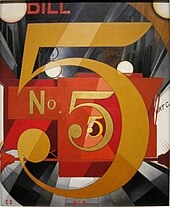
Although both British and American pop art began during the 1950s, Marcel Duchamp and others in Europe like Francis Picabia and Man Ray predate the move; in addition in that location were some earlier American proto-popular origins which utilized "as found" cultural objects.[iv] During the 1920s, American artists Patrick Henry Bruce, Gerald Irish potato, Charles Demuth and Stuart Davis created paintings that contained pop culture imagery (mundane objects culled from American commercial products and advert blueprint), about "prefiguring" the popular art move.[viii] [9]
Great britain: the Independent Group [edit]
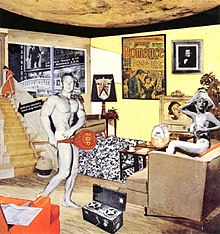
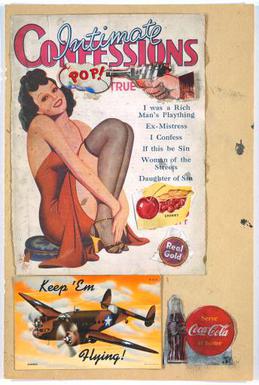
The Independent Group (IG), founded in London in 1952, is regarded as the forerunner to the pop art movement.[2] [10] They were a gathering of young painters, sculptors, architects, writers and critics who were challenging prevailing modernist approaches to civilisation as well every bit traditional views of fine fine art. Their group discussions centered on popular civilization implications from elements such equally mass advertizement, movies, product design, comic strips, science fiction and technology. At the first Contained Group coming together in 1952, co-founding member, creative person and sculptor Eduardo Paolozzi presented a lecture using a series of collages titled Bunk! that he had assembled during his time in Paris between 1947 and 1949.[2] [10] This material of "found objects" such as advertizing, comic book characters, magazine covers and various mass-produced graphics mostly represented American popular civilization. I of the collages in that presentation was Paolozzi's I was a Rich Human's Plaything (1947), which includes the first utilize of the word "popular", actualization in a cloud of fume emerging from a revolver.[2] [eleven] Following Paolozzi'southward seminal presentation in 1952, the IG focused primarily on the imagery of American popular culture, particularly mass advertising.[6]
According to the son of John McHale, the term "pop art" was first coined by his father in 1954 in conversation with Frank Cordell,[12] although other sources credit its origin to British critic Lawrence Alloway.[13] [14] (Both versions agree that the term was used in Contained Group discussions by mid-1955.)
"Pop art" as a moniker was then used in discussions by IG members in the 2d Session of the IG in 1955, and the specific term "pop art" first appeared in published print in the commodity "But Today We Collect Ads" past IG members Alison and Peter Smithson in Ark magazine in 1956.[xv] However, the term is often credited to British art critic/curator Lawrence Alloway for his 1958 essay titled The Arts and the Mass Media, even though the precise linguistic communication he uses is "popular mass civilization".[16] "Furthermore, what I meant past it then is not what information technology means now. I used the term, and also 'Pop Civilization' to refer to the products of the mass media, not to works of art that draw upon popular culture. In any example, sometime between the winter of 1954–55 and 1957 the phrase acquired currency in conversation..."[17] Nevertheless, Alloway was ane of the leading critics to defend the inclusion of the imagery of mass civilization in the fine arts. Alloway clarified these terms in 1966, at which fourth dimension Pop Art had already transited from art schools and small galleries to a major force in the artworld. Only its success had not been in England. Practically simultaneously, and independently, New York Urban center had become the hotbed for Pop Art.[17]
In London, the annual Majestic Club of British Artists (RBA) exhibition of young talent in 1960 first showed American pop influences. In January 1961, the almost famous RBA-Immature Contemporaries of all put David Hockney, the American R B Kitaj, New Zealander Baton Apple, Allen Jones, Derek Boshier, Joe Tilson, Patrick Caulfield, Peter Phillips, Pauline Boty and Peter Blake on the map; Apple tree designed the posters and invitations for both the 1961 and 1962 Young Contemporaries exhibitions.[xviii] Hockney, Kitaj and Blake went on to win prizes at the John-Moores-Exhibition in Liverpool in the aforementioned year. Apple and Hockney traveled together to New York during the Royal College's 1961 summer break, which is when Apple tree kickoff fabricated contact with Andy Warhol – both subsequently moved to the U.s. and Apple became involved with the New York pop art scene.[18]
The states [edit]
Although pop art began in the early 1950s, in America it was given its greatest impetus during the 1960s. The term "pop art" was officially introduced in December 1962; the occasion was a "Symposium on Pop Art" organized by the Museum of Modern Art.[xix] Past this time, American advertising had adopted many elements of modern art and functioned at a very sophisticated level. Consequently, American artists had to search deeper for dramatic styles that would altitude art from the well-designed and clever commercial materials.[6] As the British viewed American pop culture imagery from a somewhat removed perspective, their views were oftentimes instilled with romantic, sentimental and humorous overtones. By dissimilarity, American artists, bombarded every day with the variety of mass-produced imagery, produced work that was generally more bold and ambitious.[10]

According to historian, curator and critic Henry Geldzahler, "Ray Johnson's collages Elvis Presley No. 1 and James Dean stand as the Plymouth Rock of the Pop movement."[xx] Writer Lucy Lippard wrote that "The Elvis ... and Marilyn Monroe [collages] ... heralded Warholian Pop."[21] Johnson worked as a graphic designer, met Andy Warhol by 1956 and both designed several volume covers for New Directions and other publishers. Johnson began mailing out whimsical flyers advertising his blueprint services printed via beginning lithography. He later became known equally the father of mail art as the founder of his "New York Correspondence Schoolhouse," working small-scale past stuffing clippings and drawings into envelopes rather than working larger like his contemporaries.[22] A note about the comprehend image in January 1958'southward Art News pointed out that "[Jasper] Johns' first ane-man show ... places him with such better-known colleagues as Rauschenberg, Twombly, Kaprow and Ray Johnson".[23]
Indeed, two other important artists in the establishment of America'due south pop art vocabulary were the painters Jasper Johns and Robert Rauschenberg.[x] Rauschenberg, who like Ray Johnson attended Black Mountain Higher in Due north Carolina afterwards World War II, was influenced by the earlier work of Kurt Schwitters and other Dada artists, and his belief that "painting relates to both art and life" challenged the dominant modernist perspective of his time.[24] His apply of discarded readymade objects (in his Combines) and pop culture imagery (in his silkscreen paintings) connected his works to topical events in everyday America.[10] [25] [26] The silkscreen paintings of 1962–64 combined expressive brushwork with silkscreened magazine clippings from Life, Newsweek, and National Geographic. Johns' paintings of flags, targets, numbers, and maps of the U.Southward. besides three-dimensional depictions of ale cans drew attention to questions of representation in art.[27] Johns' and Rauschenberg's work of the 1950s is frequently referred to every bit Neo-Dada, and is visually singled-out from the prototypical American pop fine art which exploded in the early on 1960s.[28] [29]
Roy Lichtenstein is of equal importance to American popular art. His work, and its apply of parody, probably defines the bones premise of pop fine art better than whatever other.[x] Selecting the old-fashioned comic strip as subject field affair, Lichtenstein produces a difficult-edged, precise limerick that documents while also parodying in a soft style. Lichtenstein used oil and Magna paint in his all-time known works, such as Drowning Girl (1963), which was appropriated from the lead story in DC Comics' Cloak-and-dagger Hearts #83. (Drowning Girl is part of the collection of the Museum of Modern Art.)[30] His work features thick outlines, bold colors and Ben-Day dots to represent sure colors, as if created by photographic reproduction. Lichtenstein said, "[abstruse expressionists] put things downward on the sheet and responded to what they had done, to the color positions and sizes. My style looks completely different, but the nature of putting down lines pretty much is the same; mine just don't come out looking calligraphic, like Pollock's or Kline's."[31] Pop art merges pop and mass civilisation with fine fine art while injecting humor, irony, and recognizable imagery/content into the mix.
The paintings of Lichtenstein, like those of Andy Warhol, Tom Wesselmann and others, share a direct attachment to the commonplace image of American popular culture, but as well treat the subject in an impersonal manner clearly illustrating the idealization of mass production.[x]
Andy Warhol is probably the most famous effigy in pop art. In fact, art critic Arthur Danto once called Warhol "the nearest affair to a philosophical genius the history of fine art has produced".[nineteen] Warhol attempted to take pop beyond an artistic mode to a life way, and his work often displays a lack of human affectation that dispenses with the irony and parody of many of his peers.[32] [33]
Early U.S. exhibitions [edit]
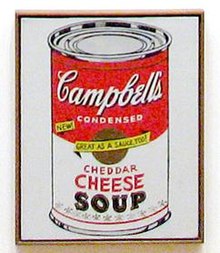
The Cheddar Cheese canvas from Andy Warhol's Campbell'south Soup Cans, 1962.
Claes Oldenburg, Jim Dine and Tom Wesselmann had their first shows in the Judson Gallery in 1959 and 1960 and later in 1960 through 1964 along with James Rosenquist, George Segal and others at the Green Gallery on 57th Street in Manhattan. In 1960, Martha Jackson showed installations and assemblages, New Media – New Forms featured Hans Arp, Kurt Schwitters, Jasper Johns, Claes Oldenburg, Robert Rauschenberg, Jim Dine and May Wilson. 1961 was the twelvemonth of Martha Jackson's spring show, Environments, Situations, Spaces.[34] [35] Andy Warhol held his beginning solo exhibition in Los Angeles in July 1962 at Irving Blum'due south Ferus Gallery, where he showed 32 paintings of Campell's soup cans, 1 for every flavor. Warhol sold the set of paintings to Blum for $1,000; in 1996, when the Museum of Modern Art acquired it, the set was valued at $15 million.[nineteen]
Donald Gene, the son of Max Factor Jr., and an art collector and co-editor of avant-garde literary magazine Nomad, wrote an essay in the mag'due south last issue, Nomad/New York. The essay was i of the beginning on what would become known every bit pop art, though Cistron did not use the term. The essay, "Four Artists", focused on Roy Lichtenstein, James Rosenquist, Jim Dine, and Claes Oldenburg.[36]
In the 1960s, Oldenburg, who became associated with the pop art movement, created many happenings, which were functioning art-related productions of that time. The name he gave to his own productions was "Ray Gun Theater". The cast of colleagues in his performances included: artists Lucas Samaras, Tom Wesselmann, Carolee Schneemann, Öyvind Fahlström and Richard Artschwager; dealer Annina Nosei; art critic Barbara Rose; and screenwriter Rudy Wurlitzer.[37] His first wife, Patty Mucha, who sewed many of his early soft sculptures, was a abiding performer in his happenings. This brash, often humorous, approach to art was at great odds with the prevailing sensibility that, by its nature, fine art dealt with "profound" expressions or ideas. In December 1961, he rented a store on Manhattan's Lower E Side to house The Store, a calendar month-long installation he had first presented at the Martha Jackson Gallery in New York, stocked with sculptures roughly in the form of consumer goods.[37]
Opening in 1962, Willem de Kooning'south New York art dealer, the Sidney Janis Gallery, organized the groundbreaking International Exhibition of the New Realists, a survey of new-to-the-scene American, French, Swiss, Italian New Realism, and British pop art. The fifty-four artists shown included Richard Lindner, Wayne Thiebaud, Roy Lichtenstein (and his painting Blam), Andy Warhol, Claes Oldenburg, James Rosenquist, Jim Dine, Robert Indiana, Tom Wesselmann, George Segal, Peter Phillips, Peter Blake (The Dearest Wall from 1961), Öyvind Fahlström, Yves Klein, Arman, Daniel Spoerri, Christo and Mimmo Rotella. The bear witness was seen past Europeans Martial Raysse, Niki de Saint Phalle and Jean Tinguely in New York, who were stunned by the size and look of the American artwork. Also shown were Marisol, Mario Schifano, Enrico Baj and Öyvind Fahlström. Janis lost some of his abstract expressionist artists when Mark Rothko, Robert Motherwell, Adolph Gottlieb and Philip Guston quit the gallery, but gained Dine, Oldenburg, Segal and Wesselmann.[38] At an opening-night soiree thrown by collector Burton Tremaine, Willem de Kooning appeared and was turned away by Tremaine, who ironically endemic a number of de Kooning'due south works. Rosenquist recalled: "at that moment I thought, something in the art world has definitely changed".[19] Turning away a respected abstruse creative person proved that, equally early as 1962, the pop fine art movement had begun to dominate fine art civilisation in New York.
A scrap earlier, on the Due west Coast, Roy Lichtenstein, Jim Dine and Andy Warhol from New York City; Phillip Hefferton and Robert Dowd from Detroit; Edward Ruscha and Joe Goode from Oklahoma Urban center; and Wayne Thiebaud from California were included in the New Painting of Common Objects show. This first pop art museum exhibition in America was curated past Walter Hopps at the Pasadena Fine art Museum.[39] Pop art was ready to change the art earth. New York followed Pasadena in 1963, when the Guggenheim Museum exhibited Half-dozen Painters and the Object, curated by Lawrence Alloway. The artists were Jim Dine, Jasper Johns, Roy Lichtenstein, Robert Rauschenberg, James Rosenquist, and Andy Warhol.[40] Some other pivotal early on exhibition was The American Supermarket organised by the Bianchini Gallery in 1964. The bear witness was presented every bit a typical small supermarket environs, except that everything in it—the produce, canned goods, meat, posters on the wall, etc.—was created past prominent popular artists of the time, including Apple, Warhol, Lichtenstein, Wesselmann, Oldenburg, and Johns. This project was recreated in 2002 as function of the Tate Gallery'due south Shopping: A Century of Art and Consumer Civilization.[41]
Past 1962, pop artists started exhibiting in commercial galleries in New York and Los Angeles; for some, it was their first commercial i-man testify. The Ferus Gallery presented Andy Warhol in Los Angeles (and Ed Ruscha in 1963). In New York, the Green Gallery showed Rosenquist, Segal, Oldenburg, and Wesselmann. The Stable Gallery showed R. Indiana and Warhol (in his outset New York show). The Leo Castelli Gallery presented Rauschenberg, Johns, and Lichtenstein. Martha Jackson showed Jim Dine and Allen Stone showed Wayne Thiebaud. By 1966, after the Green Gallery and the Ferus Gallery closed, the Leo Castelli Gallery represented Rosenquist, Warhol, Rauschenberg, Johns, Lichtenstein and Ruscha. The Sidney Janis Gallery represented Oldenburg, Segal, Dine, Wesselmann and Marisol, while Allen Stone connected to represent Thiebaud, and Martha Jackson continued representing Robert Indiana.[42]
In 1968, the São Paulo ix Exhibition – Environment United statesA.: 1957–1967 featured the "Who's Who" of popular art. Considered as a summation of the classical phase of the American pop art menstruum, the exhibit was curated by William Seitz. The artists were Edward Hopper, James Gill, Robert Indiana, Jasper Johns, Roy Lichtenstein, Claes Oldenburg, Robert Rauschenberg, Andy Warhol and Tom Wesselmann.[43]
France [edit]
Nouveau réalisme refers to an artistic movement founded in 1960 past the art critic Pierre Restany[44] and the creative person Yves Klein during the offset collective exposition in the Apollinaire gallery in Milan. Pierre Restany wrote the original manifesto for the group, titled the "Constitutive Announcement of New Realism," in April 1960, proclaiming, "Nouveau Réalisme—new ways of perceiving the real."[45] This articulation declaration was signed on 27 October 1960, in Yves Klein's workshop, by 9 people: Yves Klein, Arman, Martial Raysse, Pierre Restany, Daniel Spoerri, Jean Tinguely and the Ultra-Lettrists, Francois Dufrêne, Raymond Hains, Jacques de la Villeglé; in 1961 these were joined past César, Mimmo Rotella, and then Niki de Saint Phalle and Gérard Deschamps. The artist Christo showed with the grouping. Information technology was dissolved in 1970.[45]
Gimmicky of American Pop Art—ofttimes conceived as its transposition in France—new realism was forth with Fluxus and other groups i of the numerous tendencies of the advanced in the 1960s. The grouping initially chose Squeamish, on the French Riviera, as its home base since Klein and Arman both originated there; new realism is thus often retrospectively considered past historians to be an early representative of the École de Nice move.[46] In spite of the diversity of their plastic language, they perceived a mutual basis for their work; this being a method of direct appropriation of reality, equivalent, in the terms used past Restany; to a "poetic recycling of urban, industrial and advertizing reality".[47]
Spain [edit]
In Spain, the study of pop art is associated with the "new figurative", which arose from the roots of the crisis of informalism. Eduardo Approach could exist said to fit inside the pop art tendency, on account of his interest in the surround, his critique of our media civilization which incorporates icons of both mass media communication and the history of painting, and his contemptuousness for nearly all established artistic styles. However, the Spanish artist who could be considered almost authentically part of "pop" fine art is Alfredo Alcaín, because of the apply he makes of pop images and empty spaces in his compositions.
Also in the category of Spanish pop art is the "Chronicle Team" (El Equipo Crónica), which existed in Valencia betwixt 1964 and 1981, formed by the artists Manolo Valdés and Rafael Solbes. Their movement tin can exist characterized as "pop" considering of its utilize of comics and publicity images and its simplification of images and photographic compositions. Filmmaker Pedro Almodóvar emerged from Madrid'southward "La Movida" subculture of the 1970s making low budget super eight popular art movies, and he was subsequently chosen the Andy Warhol of Spain by the media at the time. In the book Almodovar on Almodovar, he is quoted as saying that the 1950s moving-picture show "Funny Face" was a central inspiration for his work. One pop trademark in Almodovar's films is that he always produces a faux commercial to be inserted into a scene.
New Zealand [edit]
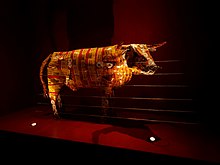
In New Zealand, pop art has predominately flourished since the 1990s, and is oft continued to Kiwiana. Kiwiana is a pop-centered, idealised representation of classically Kiwi icons, such equally meat pies, kiwifruit, tractors, jandals, Four Square supermarkets; the inherent campness of this is often subverted to signify cultural messages.[48] Dick Frizzell is a famous New Zealand popular creative person, known for using older Kiwiana symbols in means that parody mod culture. For example, Frizzell enjoys imitating the work of foreign artists, giving their works a unique New Zealand view or influence. This is done to prove New Zealand's historically subdued impact on the earth; naive art is connected to Aotearoan pop art this style.[49]
This tin can be also done in an abrasive and deadpan way, equally with Michel Tuffrey's famous piece of work Pisupo Lua Afe (Corned Beef 2000). Of Samoan ancestry, Tuffery constructed the work, which represents a bull, out of processed nutrient cans known as pisupo. It is a unique work of western pop art because Tuffrey includes themes of neocolonialism and racism against non-western cultures (signified by the nutrient cans the work is made of, which represent economical dependence brought on Samoans by the westward). The undeniable indigenous viewpoint makes it stand out against more common non-ethnic works of pop art.[fifty] [51]
1 of New Zealand's earliest and famous pop artists is Baton Apple, one of the few non-British members of the Imperial Society of British Artists. Featured among the likes of David Hockney, American R.B. Kitaj and Peter Blake in the January 1961 RBA exhibition Immature Contemporaries, Apple quickly became an iconic international artist of the 1960s. This was before he conceived his moniker of 'Billy Apple", and his work was displayed under his nativity name of Barrie Bates. He sought to distinguish himself by advent as well equally name, so bleached his hair and eyebrows with Lady Clairol Instant Creme Whip. Later, Apple was associated with the 1970s Conceptual Art motion. [52]
Japan [edit]
In Japan, pop art evolved from the nation's prominent avant-garde scene. The use of images of the modern globe, copied from magazines in the photomontage-style paintings produced by Harue Koga in the late 1920s and early 1930s, foreshadowed elements of pop art.[53] The Japanese Gutai motion led to a 1958 Gutai exhibition at Martha Jackson'southward New York gallery that preceded by two years her famous New Forms New Media prove that put Pop Art on the map.[54] The piece of work of Yayoi Kusama contributed to the development of popular fine art and influenced many other artists, including Andy Warhol.[55] [56] In the mid-1960s, graphic designer Tadanori Yokoo became one of the most successful popular artists and an international symbol for Japanese pop fine art. He is well known for his advertisements and creating artwork for pop culture icons such as commissions from The Beatles, Marilyn Monroe, and Elizabeth Taylor, amidst others.[57] Another leading popular artist at that time was Keiichi Tanaami. Iconic characters from Japanese manga and anime have too become symbols for pop art, such as Speed Racer and Astro Male child. Japanese manga and anime likewise influenced after pop artists such as Takashi Murakami and his superflat movement.
Italian republic [edit]
In Italian republic, by 1964, pop art was known and took dissimilar forms, such as the "Scuola di Piazza del Popolo" in Rome, with pop artists such as Mario Schifano, Franco Angeli, Giosetta Fioroni, Tano Festa, Claudio Cintoli, and some artworks by Piero Manzoni, Lucio Del Pezzo, Mimmo Rotella and Valerio Adami.
Italian pop art originated in 1950s culture – the works of the artists Enrico Baj and Mimmo Rotella to be precise, rightly considered the forerunners of this scene. In fact, information technology was effectually 1958–1959 that Baj and Rotella abased their previous careers (which might be generically defined as belonging to a not-representational genre, despite beingness thoroughly postal service-Dadaist), to catapult themselves into a new world of images, and the reflections on them, which was springing up all effectually them. Rotella'south torn posters showed an ever more figurative taste, often explicitly and deliberately referring to the great icons of the times. Baj's compositions were steeped in contemporary kitsch, which turned out to exist a "gold mine" of images and the stimulus for an entire generation of artists.
The novelty came from the new visual panorama, both within "domestic walls" and out-of-doors. Cars, route signs, television receiver, all the "new world", everything can belong to the world of art, which itself is new. In this respect, Italian pop art takes the same ideological path equally that of the international scene. The only affair that changes is the iconography and, in some cases, the presence of a more critical attitude toward it. Even in this case, the prototypes tin can be traced dorsum to the works of Rotella and Baj, both far from neutral in their relationship with club. Yet this is not an sectional chemical element; at that place is a long line of artists, including Gianni Ruffi, Roberto Barni, Silvio Pasotti, Umberto Bignardi, and Claudio Cintoli, who take on reality as a toy, as a smashing puddle of imagery from which to depict material with disenchantment and frivolity, questioning the traditional linguistic part models with a renewed spirit of "let me have fun" à la Aldo Palazzeschi.[58]
Belgium [edit]
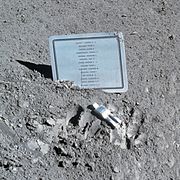
In Kingdom of belgium, popular art was represented to some extent by Paul Van Hoeydonck, whose sculpture Fallen Astronaut was left on the Moon during i of the Apollo missions, besides as by other notable pop artists. Internationally recognized artists such as Marcel Broodthaers ( 'vous êtes doll? "), Evelyne Axell and Panamarenko are indebted to the pop fine art motility; Broodthaers'due south great influence was George Segal. Another well-known artist, Roger Raveel, mounted a birdcage with a real live pigeon in one of his paintings. By the finish of the 1960s and early on 1970s, popular art references disappeared from the work of some of these artists when they started to adopt a more critical attitude towards America because of the Vietnam War's increasingly gruesome character. Panamarenko, however, has retained the irony inherent in the pop art movement up to the present mean solar day. Evelyne Axell from Namur was a prolific pop-artist in the 1964–1972 period. Axell was one of the outset female pop artists, had been mentored past Magritte and her best-known painting is Ice Cream.[59]
Netherlands [edit]
While there was no formal pop art motility in holland, in that location were a group of artists that spent time in New York during the early years of popular art, and drew inspiration from the international pop fine art movement. Representatives of Dutch popular art include Daan van Golden, Gustave Asselbergs, Jacques Frenken, Jan Cremer, Wim T. Schippers, and Woody van Amen. They opposed the Dutch petit bourgeois mentality by creating humorous works with a serious undertone. Examples of this nature include Sex activity O'Clock, past Woody van Amen, and Crucifix / Target, past Jacques Frenken.[60]
Russia [edit]
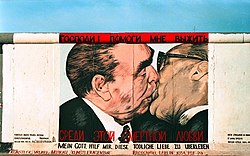
Russia was a little late to become office of the pop fine art move, and some of the artwork that resembles pop fine art only surfaced effectually the early on 1970s, when Russia was a communist country and bold artistic statements were closely monitored. Russia'due south own version of popular art was Soviet-themed and was referred to as Sots Art. After 1991, the Communist Party lost its ability, and with it came a freedom to express. Popular fine art in Russian federation took on another form, epitomised by Dmitri Vrubel with his painting titled My God, Assistance Me to Survive This Mortiferous Dearest in 1990. It might exist argued that the Soviet posters made in the 1950s to promote the wealth of the nation were in itself a form of pop art.[61]
Notable artists [edit]
- Billy Apple (1935-2021)
- Evelyne Axell (1935–1972)
- Sir Peter Blake (built-in 1932)
- Derek Boshier (born 1937)
- Pauline Boty (1938–1966)
- Patrick Caulfield (1936–2005)
- Allan D'Arcangelo (1930–1998)
- Jim Dine (born 1935)
- Burhan Dogancay (1929–2013)
- Rosalyn Drexler (born 1926)
- Robert Dowd (1936–1996)
- Ken Elias (born 1944)
- Erró (born 1932)
- Marisol Escobar (1930–2016)
- James Gill (built-in 1934)
- Dorothy Grebenak (1913-1990)
- Crimson Grooms (born 1937)
- Richard Hamilton (1922–2011)
- Keith Haring (1958–1990)
- Jann Haworth (born 1942)
- David Hockney (born 1937)
- Dorothy Iannone (born 1933)
- Robert Indiana (1928–2018)
- Jasper Johns (built-in 1930)
- Ray Johnson (1927-1995)
- Allen Jones (born 1937)
- Alex Katz (born 1927)
- Corita Kent (1918–1986)
- Konrad Klapheck (born 1935)
- Kiki Kogelnik (1935–1997)
- Nicholas Krushenick (1929–1999)
- Yayoi Kusama (built-in 1929)
- Gerald Laing (1936–2011)
- Roy Lichtenstein (1923–1997)
- Richard Lindner (1901–1978)
- John McHale (1922–1978)
- Peter Max (born 1937)
- Marta Minujin (born 1943)
- Claes Oldenburg (born 1929)
- Julian Opie (built-in 1958)
- Eduardo Paolozzi (1924–2005)
- Peter Phillips (born 1939)
- Sigmar Polke (1941–2010)
- Hariton Pushwagner (1940–2018)
- Mel Ramos (1935–2018)
- Robert Rauschenberg (1925–2008)
- Larry Rivers (1923–2002)
- James Rizzi (1950–2011)
- James Rosenquist (1933–2017)
- Niki de Saint Phalle (1930–2002)
- Peter Saul (born 1934)
- George Segal (1924–2000)
- Colin Self (born 1941)
- Marjorie Strider (1931–2014)
- Elaine Sturtevant (1924-2014)
- Wayne Thiebaud (born 1920)
- Joe Tilson (built-in 1928)
- Andy Warhol (1928–1987)
- Idelle Weber (1932–2020)
- John Wesley (born 1928)
- Tom Wesselmann (1931–2004)
See as well [edit]
- Fine art pop
- Chicago Imagists
- Ferus Gallery
- Sidney Janis
- Leo Castelli
- Green Gallery
- New Painting of Common Objects
- Figuration Libre (fine art motility)
- Lowbrow (art movement)
- Nouveau réalisme
- Neo-popular
- Op art
- Plop art
- Retro fine art
- Superflat
- SoFlo Superflat
References [edit]
- ^ Popular Art: A Brief History, MoMA Learning
- ^ a b c d due east Livingstone, M., Pop Fine art: A Standing History, New York: Harry Due north. Abrams, Inc., 1990
- ^ a b c de la Croix, H.; Tansey, R., Gardner's Art Through the Ages, New York: Harcourt Brace Jovanovich, Inc., 1980.
- ^ a b c d eastward f Piper, David. The Illustrated History of Art, ISBN 0-7537-0179-0, p486-487.
- ^ Harrison, Sylvia (2001-08-27). Popular Fine art and the Origins of Post-Modernism. Cambridge Academy Press.
- ^ a b c d Gopnik, A.; Varnedoe, 1000., High & Low: Modern Art & Pop Culture, New York: The Museum of Modern Art, 1990
- ^ "History, Travel, Arts, Science, People, Places | Smithsonian". Smithsonianmag.com . Retrieved 2015-12-30 .
- ^ "Modern Honey". The New Yorker. 2007-08-06. Retrieved 2015-12-30 .
- ^ Wayne Craven, American Fine art: History and . p.464.
- ^ a b c d east f g Arnason, H., History of Modern Art: Painting, Sculpture, Compages, New York: Harry N. Abrams, Inc. 1968.
- ^ "'I was a Rich Human being's Plaything', Sir Eduardo Paolozzi". Tate. 2015-12-10. Retrieved 2015-12-30 .
- ^ "John McHale". Warholstars.org . Retrieved 2015-12-30 .
- ^ "Pop fine art", A Dictionary of Twentieth-Century Art, Ian Chilvers. Oxford University Press, 1998.
- ^ "Pop art", The Concise Oxford Dictionary of Art Terms, Michael Clarke, Oxford Academy Printing, 2001.
- ^ Alison and Peter Smithson, "But Today We Collect Ads", reprinted on page 54 in Mod Dreams The Ascent and Autumn of Pop, published by ICA and MIT, ISBN 0-262-73081-two
- ^ Lawrence Alloway, "The Arts and the Mass Media," Architectural Blueprint & Construction, February 1958.
- ^ a b Klaus Honnef, Pop Art, Taschen, 2004, p. vi, ISBN 3822822183
- ^ a b Barton, Christina (2010). Billy Apple: British and American Works 1960–69. London: The Mayor Gallery. pp. xi–21. ISBN978-0-9558367-iii-2.
- ^ a b c d Scherman, Tony. "When Pop Turned the Art World Upside Downward." American Heritage 52.1 (Feb 2001), 68.
- ^ Geldzahler, Henry in Pop Fine art: 1955–1970 catalogue, Art Gallery of New Due south Wales, Sydney, 1985
- ^ Lippard, Lucy in Ray Johnson: Correspondences catalogue, Wexner Center/Whitney Museum, 2000
- ^ Bloch, Mark. "An Illustrated Introduction to Ray Johnson 1927-1995", 1995
- ^ Writer unknown. "(Table of contents, Untitled note about embrace.)", Art News, vol. 56, no. 9, January 1958
- ^ Rauschenberg, Robert; Miller, Dorothy C. (1959). Sixteen Americans [exhibition]. New York: Museum of Modern Art. p. 58. ISBN 978-0029156704. OCLC 748990996. "Painting relates to both art and life. Neither can be fabricated. (I attempt to deed in that gap between the ii.)"
- ^ "Fine art: Pop Art – Cult of the Commonplace". Fourth dimension. 1963-05-03. ISSN 0040-781X. Retrieved 2020-07-07 .
Robert Rauschenberg, 37, remembers an art teacher who 'taught me to call up, "Why not?"' Since Rauschenberg is considered to be a pioneer in popular art, this is probably where the move went off on its particular tangent. Why not make art out of old newspapers, bits of clothing, Coke bottles, books, skates, clocks?
- ^ Sandler, Irving H. The New York School: The Painters and Sculptors of the Fifties, New York: Harper & Row, 1978. ISBN 0-06-438505-1 pp. 174–195, Rauschenberg and Johns; pp. 103–111, Rivers and the gestural realists.
- ^ Rosenthal, Nan (October 2004). "Jasper Johns (born 1930) In Heilbrunn Timeline of Fine art History". The Metropolitan Museum of Fine art . Retrieved May ii, 2021.
- ^ Robert Rosenblum, "Jasper Johns" Art International (September 1960): 75.
- ^ Hapgood, Susan, Neo-Dada: Redefining Art, 1958–62. New York: Universe Books, 1994.
- ^ Hendrickson, Janis (1988). Roy Lichtenstein. Cologne, Germany: Benedikt Taschen. p. 31. ISBN3-8228-0281-vi.
- ^ Kimmelman, Michael (September 30, 1997). "Roy Lichtenstein, Pop Principal, Dies at 73". New York Times . Retrieved November 12, 2007.
- ^ Michelson, Annette, Buchloh, B. H. D. (eds) Andy Warhol (October Files), MIT Press, 2001.
- ^ Warhol, Andy. The Philosophy of Andy Warhol, from A to B and dorsum once again. Harcourt Caryatid Jovanovich, 1975
- ^ "The Drove". MoMA.org . Retrieved 2015-12-30 .
- ^ "The Great American Pop Art Store: Multiples of the Sixties". Tfaoi.com . Retrieved 2015-12-30 .
- ^ Diggory (2013).
- ^ a b Kristine McKenna (July ii, 1995), When Bigger Is Better: Claes Oldenburg has spent the past 35 years bravado upwardly and redefining everyday objects, all in the name of getting fine art off its pedestal Los Angeles Times.
- ^ Reva Wolf (1997-11-24). Andy Warhol, Poesy, and Gossip in the 1960s. p. 83. ISBN9780226904931 . Retrieved 2015-12-30 .
- ^ "Museum History » Norton Simon Museum". Nortonsimon.org . Retrieved 2015-12-30 .
- ^ Six painters and the object. Lawrence Alloway [curator, conceived and prepared this exhibition and the catalogue] (Figurer file). 2009-07-24. OCLC 360205683.
- ^ Gayford, Martin (2002-12-19). "Even so life at the cheque-out". The Telegraph. Telegraph Media Grouping Ltd. Archived from the original on 2022-01-eleven. Retrieved 28 November 2012.
- ^ Popular Artists: Andy Warhol, Pop Art, Roy Lichtenstein, Jasper Johns, Peter Max, Erró, David Hockney, Wally Hedrick, Michael Leavitt (May 20, 2010) Reprinted: 2010, General Books, Memphis, Tennessee, USA, ISBN 978-1-155-48349-8, ISBN 1-155-48349-nine.
- ^ Jim Edwards, William Emboden, David McCarthy: Uncommonplaces: The Fine art of James Francis Gill, 2005, p.54
- ^ Karl Ruhrberg, Ingo F. Walther, Art of the 20th Century, Taschen, 2000, p. 518. ISBN iii-8228-5907-9
- ^ a b Kerstin Stremmel, Realism, Taschen, 2004, p. 13. ISBN 3-8228-2942-0
- ^ Rosemary Thousand. O'Neill, Art and Visual Culture on the French Riviera, 1956–1971: The Ecole de Overnice, Ashgate, 2012, p. 93.
- ^ 60/90. Trente ans de Nouveau Réalisme, La Différence, 1990, p. 76
- ^ "Op + Pop". christchurchartgallery.org.nz . Retrieved 2021-07-22 .
- ^ "Dick Frizzell - Overview". The Central . Retrieved 2021-07-22 .
- ^ "Loading... | Collections Online - Museum of New Zealand Te Papa Tongarewa". collections.tepapa.govt.nz . Retrieved 2021-07-22 .
- ^ "Loading... | Collections Online - Museum of New Zealand Te Papa Tongarewa". collections.tepapa.govt.nz . Retrieved 2021-07-22 .
- ^ "ARTSPACE - Baton Apple tree". 2013-02-09. Archived from the original on 2013-02-09. Retrieved 2021-07-29 .
- ^ Eskola, Jack (2015). Harue Koga: David Bowie of the Early 20th Century Japanese Fine art Avant-garde. Kindle, eastward-volume.
- ^ Bloch, Marker. The Brooklyn Rail. "Gutai: 1953 –1959", June 2018.
- ^ "Yayoi Kusama interview – Yayoi Kusama exhibition". Timeout.com. 2013-01-thirty. Retrieved 2015-12-30 .
- ^ [ane] Archived November 1, 2012, at the Wayback Machine
- ^ "Tadanori Yokoo : ADC • Global Awards & Social club". Adcglobal.org. 1936-06-27. Retrieved 2015-12-30 .
- ^ "Pop Art Italia 1958–1968 — Galleria Civica". Comune.modena.it . Retrieved 2015-12-30 .
- ^ "Philadelphia Museum of Art Wins Fight with Facebook over Racy Pop Fine art Painting". artnet.com. xi Feb 2016. Retrieved 2020-01-17 .
- ^ "Dutch Pop Art & The Sixties – Weg met de vertrutting!". 8weekly.nl. 28 July 2005. Retrieved 2015-12-30 .
- ^ [2] Archived June vii, 2013, at the Wayback Machine
Further reading [edit]
- Bloch, Mark. The Brooklyn Rails. "Gutai: 1953 –1959", June 2018.
- Diggory, Terence (2013) Encyclopedia of the New York School Poets (Facts on File Library of American Literature). ISBN 978-ane-4381-4066-vii
- Francis, Marker and Foster, Hal (2010) Pop. London and New York: Phaidon.
- Haskell, Barbara (1984) BLAM! The Explosion of Pop, Minimalism and Operation 1958–1964. New York: Due west.W. Norton & Company, Inc. in association with the Whitney Museum of American Art.
- Lifshitz, Mikhail, The Crisis of Ugliness: From Cubism to Pop-Art. Translated and with an Introduction by David Riff. Leiden: BRILL, 2018 (originally published in Russian by Iskusstvo, 1968).
- Lippard, Lucy R. (1966) Pop Art, with contributions past Lawrence Alloway, Nancy Marmer, Nicolas Calas, Frederick A. Praeger, New York.
- Selz, Peter (moderator); Ashton, Dore; Geldzahler, Henry; Kramer, Hilton; Kunitz, Stanley and Steinberg, Leo (Apr 1963) "A symposium on Pop Art" Arts Magazine, pp. 36–45. Transcript of symposium held at the Museum of Modern Art on December 13, 1962.
External links [edit]
 | Wikimedia Commons has media related to Pop art. |
 | Wikiquote has quotations related to: Pop art |
- Pop Fine art: A Cursory History, MoMA Learning
- Pop Art in Modern and Contemporary Art, The Met
- Brooklyn Museum Exhibitions: Seductive Subversion: Women Pop Artists, 1958–1968, Oct. 2010-January. 2011
- Brooklyn Museum, Wiki/Pop (Women Pop Artists)
- Tate Glossary term for Pop art
Source: https://en.wikipedia.org/wiki/Pop_art
0 Response to "Ark How to Make Uploaded Canvas Picture Non Comicy"
Post a Comment