Numerical composition and Revelation’s unity
 Final week I read a fascinating commodity by Mike Parsons of Baylor University on 'Exegesis "Past the Numbers": Numerology and the New Testament.' It gives an overview of some of the means that numbers features in the limerick of the text. Some are well-known, but a good number were new to me. For example, apart from the large number of occurrences of the number seven (88 times), 7 also serves every bit a structuring principle:
- John's gospel begins and ends with a series of seven days (which you lot have to count).
- John 2.13–eleven is organised around vii events which demonstrate that Jesus both fulfils and supersedes Jewish worship.
- There are seven 'I am' sayings in John.
- The genealogy in Matt 1 is structured around 14 = 7 x 2 generations.
- The opening narrative of Matt one-4 contains seven fulfillments of Scripture by Jesus (i:22-23; ii:5-half-dozen, 15, 17, 23; 3:3; four:14).
- Matthew 13 is a collection of seven parables nearly the kingdom of sky.
- Matthew 23 is a collection of seven woes.
- In Rom 3: 10–18, Paul quotes seven Old Testament passages that have been collected together to evidence the accuse that both Jews and Gentiles are under sin.
It is worth noting that these observations are quite different from two other ways of including numerology in exegesis. The third century Saint Methodius of Olympus wrote a treatise on virginity, in which he comments on Revelation, and interprets the 1260 days of Rev 12 as a sign of the Trinity (1000 = the Male parent, 100 + 100 = the ii natures of the Son, and threescore = the Spirit). This is imposing a numerological scheme on the text rather than observing what the writer might accept been thinking of. Another way of using numerology is to demonstrate the 'divine authorship' of the scriptures by finding numerical patterns across difference books, often including reference to affiliate and verse numbers. One of the most pop here the often-repeated exclamation that Ps 118.8 is the middle verse of the Bible—which it isn't. All these kinds of theories fail to recognise that the chapter and verse numbering was not part of the original composition of the text, only a much subsequently addition.
By contrast, Parsons recognises that numerical composition reflects the importance of numerological symbolism to the ancient writers. He quotes Francois Bovon of Harvard and Adela Collins of Yale:
It is my hypothesis that the early Christians used the categories of 'proper noun' and 'number' equally theological tools. Ofttimes they consciously interpreted names and numbers in a symbolic mode. (Bovon)
Numerical symbolism is office of the activity of discovering club in environment and experience . . . . Starting time, [numerical symbolism] is used to society the feel of time . . . . Numerical symbolism as well expresses guild in the experience of space. The perception of such order is expressed in the Greek thought of the creation. (Collins).
This is expressed even in the limerick of the NT canon. Have y'all ever noticed that we have Pauline letters to seven churches (Romans, Corinthians, Galatians, Ephesians, Philippians, Colossians, Thessalonians) and four letters to individuals (Titus, 1 and 2 Timothy, Philemon)? (Information technology looks as though part of the reason for the inclusion of Hebrews in early on text collections was to make up the total number of these 'Pauline' letters to 14.) And that in that location are 7 'catholic' epistles (one and 2 Peter; i, ii, and 3 John; James; Jude)?
Numbers in the text are also connected with gematria or isopsephism, the numerical evaluation of words (in a globe without a divide number system). Parsons notes the unusual occurrence of the number 18, only 3 times in the NT, all three times in Luke, and two of them in a unique repetition of a period of affliction (Luke 13.11, 16; the third occurrence is Luke 13.4, the number who died when the belfry of Siloam fell). The odd affair about this repetition is that the second fourth dimension the number is spelt out differently. In 13.eleven we have the worddekaokto, simply in 13.16 information technology is expressed asdeka kai onto.Parsons cites other early texts to demonstrate that Luke is connecting the healing of the crippled woman with the proper name of Jesus. The common manuscript abbreviation (thenomen sacrum) consists of the outset two letters of Jesus' proper name, whose numerical values add upward to xviii.
Parsons' study includes an interpretation of the 153 fish in John 21 and the 276 people in the ship in Acts 27—but I will leave you to read about these for yourself. Although these kinds of observations seem very strange to the modernistic reader—since we would not treat words and numbers in this mode or with this significance—this is all role of disciplined, critical reading of the text. All we are doing hither is reading the texts in the ways in which the author and his (her) starting time readers themselves would have done.
On the field of study of word frequencies, Richard Bauckham has long been an abet of the importance of word frequencies and patterns in reading Revelation. (Steve Moyise offered a critique of his approach in a 2005 newspaper, just I haven't found Moyise' objections persuasive). Autonomously from contributing to the meaning of Revelation and shaping our interpretation of information technology, these give-and-take frequencies tin can besides in passing shed low-cal on the vexed question of whether Revelation is a unity or a collection of originally disparate texts.
Some years ago, I mapped words with special frequencies confronting the compositional units proposed past David Aune in his Word commentary—and plant there was no correlation whatever. (Click on the chart to encounter a larger version).
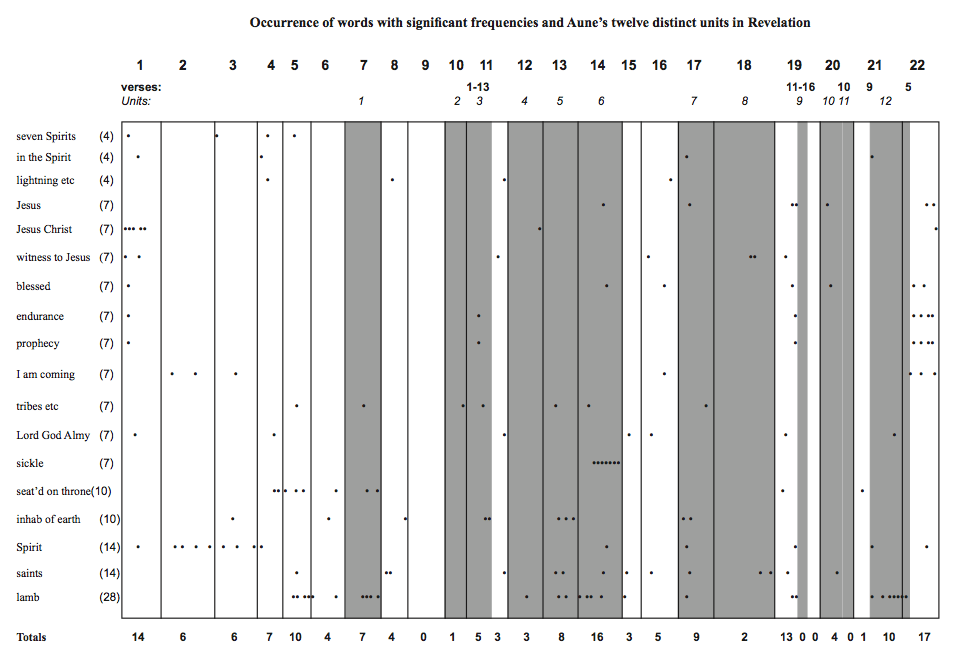 This tells us that, if Revelation was originally composite, it has been so thoroughly edited that all trace of the original components has now been lost to us.
Much of my work is done on a freelance footing. If y'all have valued this mail service, would y'all consider donating £ane.20 a month to support the production of this blog?
If yous enjoyed this, do share it on social media (Facebook or Twitter) using the buttons on the left. Follow me on Twitter @psephizo. Like my folio on Facebook.
Much of my work is done on a freelance basis. If you have valued this mail service, you lot tin make a single or repeat donation through PayPal:
For other ways to back up this ministry, visit my Back up folio.
Comments policy: Good comments that engage with the content of the mail service, and share in respectful fence, tin add existent value. Seek first to understand, and then to be understood. Make the nigh charitable construal of the views of others and seek to larn from their perspectives. Don't view debate equally a conflict to win; accost the argument rather than tackling the person.
Source: https://www.psephizo.com/revelation/numerical-composition-and-revelations-unity/
0 Response to "Numerical composition and Revelation’s unity"
Post a Comment